From Heathrow: a Grab Bag
I’ve been on the road the last two Sundays. Now, with a moment to catch my breath, a batch of goodies while I’m waiting for my plane to board. (Issue #189)

I’ll probably take next Sunday off because I’ll be busy with family on Thanksgiving weekend, so expect the next Dispatch on Sunday, December 7th.
In no particular order…
Unmediated: I’ve been in London and Paris as part of my role with Ascendant Network, first running the program for the RMN Europe Ascendant Boot Camp, and then meetings. After, I spent the weekend seeing theater and wandering around London.
The highest bandwidth connection we humans have is being around other humans. That’s why in-the-flesh conferences work better than video conferences and why live theater is better than movies or television. I’ve talked about Eventness before, and the power of presence hit me again over the last week. I don’t think, for example, that one of my speakers would have shared news about a sick child if we were on a Zoom. Likewise, I would have had no chance to chat with Andrea (Canadian) and Katie (British) at the (surprisingly late in the play intermission) for Othello at the Haymarket.
As knowing what is real in our everyday life becomes more and more of a struggle with AI deepfakes, partisan media, and algorithms telling us what will rile us up rather than keep us informed, face-to-face, cheek-to-jowl, and side-by-side experiences will become critical because the friction of other people’s presence can slow down our hair-trigger impulses to be assholes… at least that’s my hope.
Speaking of reality… “Why Every Family Needs a Code Word“ (WSJ $) is short and important.
I admire the Abortion, Every Day newsletter. The recent piece, “Would You Wear a Period-Tracker Funded by Peter Thiel?” is startling and scary.
More on theater… I saw the weirdest double feature: The Importance of Being Earnest on Saturday afternoon and then Othello that night. Idiots falling in love followed by idiots dying for love.
Earnest starred Stephen Fry as Lady Bracknell. It’s hard to describe a man playing a woman’s part as “playing it straight,” but Fry trusted Wilde’s language and his ability to speak it. The rest of the cast played everything for camp… chewing and digesting the scenery. It was great fun, but it felt like the love child of Oscar Wilde and RuPaul’s Drag Race rather than just Wilde.
I’ve seen many productions of Othello, but I’ve never seen as strong a Desdemona as Caitlin Fitzgerald. Part of this is that she is 5’ 10” and her Othello, David Harewood, is just two inches taller. This made the murder scene a genuine and compelling struggle. Toby Jones, Iago, is 5’ 5”. He was a smoldering, diminutive presence who captured the most famous line ever written about the character: Samuel Taylor Coleridge’s quip that Iago’s casting about for reasons to hate Othello is “the motive hunting of a motiveless malignity.”
How soon will AI agents be real? This question takes up a lot of my time both as a thinker and as a conference programmer. VC Ashu Garg’s piece, “What it takes to build AI agents that actually work,” is a terrific meditation. Here’s a snippet:
Building an agent that works in a demo is now relatively straightforward. Building one that works reliably enough to run a business on remains extremely hard. You can build an 80% solution with 20% of the effort, but getting to 99% accuracy takes 100x more work.
Agentic accuracy for what milk to buy is low stakes, but what medications to order, emails to prioritize, flights to book, and when to pick up the kids are higher stakes and need higher degrees of reliability. (H/T Jim Louderback.)
A brief rant: I rejoined Shutterfly two weeks back to create and send a gift to a friend. The prices are exorbitant, but as a Costco member I get a steep discount that makes it almost affordable. I could not believe how MANY MARKETING EMAILS Shutterfly sent me in the few short days after I signed up, and the frequency seemed to increase after I made a project. It was so obnoxious that I unsubscribed from all marketing. Do better, Shutterfly!
I’m tempted by the distraction-free “Light III” mobile phone, but what I’d rather have is an iPhone app that mimics all the affordances of the Light III for a preset amount of time. WSJ ($) explores this and other such devices.
The Epstein Files continue to suck up journalistic attention, and therefore our own. Here are some worthwhile pieces:
Novelist Jennifer Weiner points out that the sharp focus on the alleged child rapists deflects attention from their victims (NYT $).
Likewise, Rachel Louise Snyder connects the failure of the justice system to hold Epstein’s co-rapists to account to the diminished promise of the #MeToo movement (NYT $).
Anand Giridharadas’ analysis, “How the Elite Behave When No One Is Watching: Inside the Epstein Emails,” is fascinating (NYT $). I particularly enjoyed when he digs into how stupid many of Epstein’s ideas were, and how patient experts were with his moronic musings because they were eager to get his money.
Most fascinating, a pair of civic-minded developers rebuilt Epstein’s Gmail account with all the contents and made it both accessible and, like all Gmail accounts, searchable. You can find it at https://jmail.world, but I warn you that access is intermittent. (H/T Howard Grey.)
The power of analogy in human thinking has long fascinated me, so I enjoyed a recent MIT Sloan Management Review article about how analogy can unlock creativity in business. I particularly like Richard L. Gruner’s notion of “conceptual wanderlust.”
Oddly, Gruner entirely missed the most important takeaway: AI doesn’t do this, so analogical thinking is a key differentiator between human intelligence and the artificial kind.
See also this rhyming piece from The Observer: “When Algorithms Curate Culture, What Do We Lose?” (Another H/T to Jim Louderback.)
South Park: “Politics became pop culture” is the theme of two articles: one from Variety on Yahoo!, and the other from NYT ($). Both are worth reading if you’re interested in how Matt Stone and Trey Parker manage to get away with eviscerating Trump while their corporate overlords seek his approval.
More entertainment news:
Bloomberg has a thoughtful and informative piece about how conservative media embraces ideological brands and vice versa on YouTube. (H/T Taylor Lorenz.)
The Economist’s “Stranger Things” and the changing business of hit-making ($) digs into how the traditional theater—>rental—>premium cable—>basic cable—> broadcast set of windows for movies is changing.
Where Do Games Go When They Die? from the Close All Tabs podcast on KQED digs into what happens when publishers shut down games. The discussion about the garment-tearing backlash when Kim Kardashian: Hollywood went away is particularly interesting.
If you like what you’re reading, please forward to a friend. Sign up is here.
On the lighter side…
This Asian version of the classic Abbott and Costello “Who’s On First” routine is hilarious even if you don’t know the original. However, if you don’t know the original, the for heaven’s sake watch it! (H/T Dave Smith.)
If you’ve been wondering what “6-7” means, this NYT piece ($) might help, but then again…
This Instagram post made me smile.
And this Threads post elicited a maniacal laugh.
Selfies from my trip:
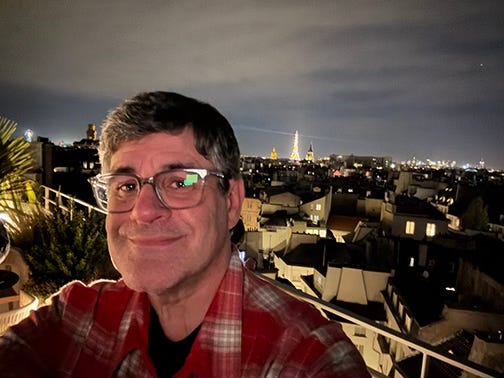
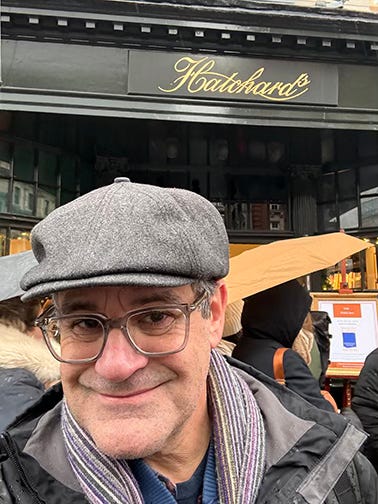
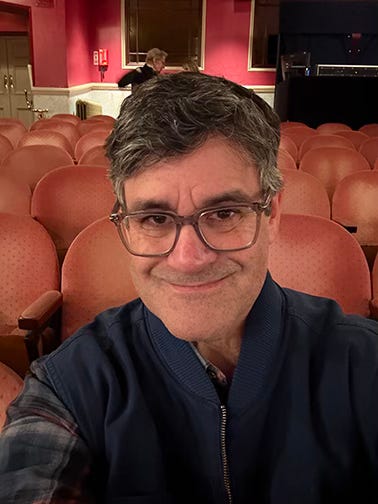


Practical Matters:
Sponsor this newsletter! Let other Dispatch readers know what your business does and why they should work with you. (Reach out here or just hit reply.)
Hire me to speak at your event! Get a sample of what I’m like onstage here.
The idea and opinions that I express here in The Dispatch are solely my own: they do not reflect the views of my employer, my consulting clients, or any of the organizations I advise.
Please follow me on Bluesky, Instagram, LinkedIn, and Threads (but not X) for between-issue insights and updates.
Thanks for reading. Happy Thanksgiving! See you Sunday, December 7th.