Keyword: Aura
Some objects carry the trace of everyone who's cared about them, and it only happens in the analog world. Plus, the return of location in culture, the death of PlayStation discs, stand-up, and more!

Before we get to today’s main topic, some miscellaneous goodies and things worth your attention…
Location Strikes Back? The June 13th issue of The Economist ($) has a Leader and a Briefing about the decline of global culture in favor of local culture. “There is an emerging paradox: even as the world becomes more connected, people are choosing more local forms of fun.” Streaming data from Spotify, for example, shows that “55% of streams of songs in Sweden’s top 20 last year were in Swedish, up from 29% in 2019.” (Spotify is a Swedish company.)
Back in 2007, I argued that lower-cost production and distribution might create an “artistic middle class,” but I missed the geography component (possibly because it didn’t exist then). Likewise, Kevin Kelly’s famous “1000 True Fans” essay was agnostic with regard to geography.
I’m still making sense of this relocalization of culture.
On Politics…
The Supreme Court upheld Birthright Citizenship! (NYT $ coverage here; LAist/NPR coverage here.) SCOTUS has mostly been lapdogs to POTUS the last couple of years, so it’s heartening to see that they have some spine. Has nobody in the MAGA crowd read the words on the base of the Statue of Liberty?
Likewise, I was pleased to see that Prof. Tamar Shirinian reached a $1.7M settlement (NYT $) with her former employer, the University of Tennessee at Knoxville, which fired her for private remarks made on Facebook about the death of Charlie Kirk. Shirinian was months from earning tenure. I hope she finds a new job at a better university soon.
Finally on politics, David Wallace-Wells has an interesting op-ed (NYT $), “The Vibe Has Shifted Back,” arguing that some of what seemed to be irrevocable changes in our government and culture since Trump returned to the White House aren’t written in laundry pen after all.
SpaceX wants to extend its Starlink service to terrestrial mobile coverage, per WSJ ($), challenging AT&T, Verizon, and T-Mobile. Why wouldn’t SpaceX simply buy a smaller Mobile Virtual Network Operator (MVNO), the way T-Mobile acquired Mint? Given the differences in market cap, SpaceX could even try to acquire AT&T, Verizon, or T-Mobile. If Musk is still in Trump’s good graces, he might even dodge the regulatory scrutiny.
No more PlayStation game discs: starting in 2028, Sony will no longer sell PlayStation games on BluRay, only download, according to this article in Wired. This effectively kills the secondary market for games, and it also creates other problems. It will be interesting to see if enough gamers protest for Sony to reconsider.
TrialThread.org: my friend Eric Porres (Chief AI Officer at Logitech) built (in a weekend!) an online platform that connects patients with clinical trials. This is a mitzvah. Read Eric’s explanation here.
If you like what you’re reading, please forward to a friend. Sign up is here.
Practical Matters:
Sponsor this newsletter! Let other Dispatch readers know what your business does and why they should work with you. (Reach out here or just hit reply.)
Hire me to speak at your event! Get a sample of what I’m like onstage here.
The ideas and opinions that I express here in The Dispatch are solely my own: they do not reflect the views of my employer, my consulting clients, or any of the organizations I advise.
Please follow me on Bluesky, Instagram, LinkedIn, and Threads (but not X) for between-issue insights and updates.
On the lighter side…
La Profesora and I celebrated the country’s 250th birthday by attending a comedy show by Zarna Garg, an Indian immigrant who has raised her three kids in America and is taking the stand-up world by storm. She’s great! See her if the show comes to your town.
Cartoonize.ai is an amusing new service that lets you transform photos into stylized cartoons. Here is a picture of my daughter and her puppy in the style of Studio Ghibli:

Star Trek: Discovery Season One holds up! On a whim, and because I’m impatient for the next season of Star Trek: Strange New Worlds to start, I restarted the first season of Discovery. It’s great! Alas, the qualitative half-life of the series was seasonal, so S2 was half as good as S1, S3 was half as good as S2, and so on. But S1 is still terrific and worth a second pass!
Supergirl: I’m avoiding reviews because I’m waiting for my son William (my superhero movie buddy since he was 4) to return from his term abroad in New Zealand.
Theo of Golden: After I mentioned how this book is a publishing phenomenon last issue, my friend Raman pinged me to say that he read and enjoyed the book. I started listening to it on Spotify, bought a paperback at Annie Bloom’s, and am making steady progress. It is an unusual book that I’m enjoying, but I don’t know where it’s going.
On to our top story...
Keyword: Aura
Any issue of The Atlantic that arrives containing a piece by Caity Weaver is a treat to be gobbled up and then re-read and savored. She is a cornucopian writer, like Erasmus in the Dutch Renaissance, who delights in lists, comparisons, nuance, and making thoughtful judgments. Weaver is also hilarious: she is in deep, intimate, and accepting contact with the posse of neuroses that attend her writing like an entourage. I celebrated her magnum opus, My Quest to Find America’s Best Free Bread, in a previous Dispatch; if you haven’t yet read it you should. Immediately.
Weaver’s latest, Cheap Thrills: The whimsy, weirdness, and heartbreak of secondhand shopping, in the July Atlantic, explores three ways that Americans get to spy on each other by looking at other people’s stuff at garage sales, thrift stores, and estate sales. It’s the third category where Weaver shows that behind the wry observations lies an insightful mind and a big heart:
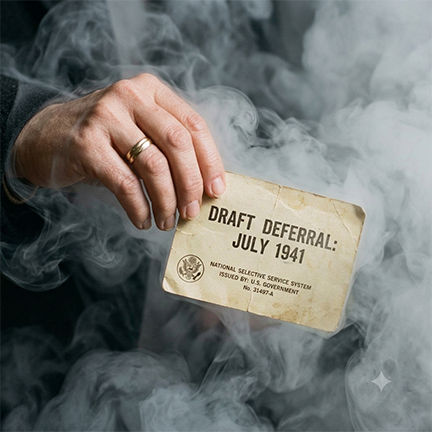
In a bedroom closet in Bernalillo, on a shelf bearing a gray-haired wig and wig shampoo, I find a government card dated five months before the attack on Pearl Harbor, stating that the cardholder, a resident of Kansas, is eligible to defer his draft by reason of hardship to his dependents. The woman ringing up my Christmas decorations lets me have it for free.
Without Weaver, that government card—which a recently deceased woman held onto for 85 years—would have wound up in the garbage. Weaver preserved, for at least another few years, the government card’s aura.
“Aura” is a term I first encountered in the early Twentieth Century critic Walter Benjamin’s famous essay, “The Work of Art in the Age of Mechanical Reproduction.” For Benjamin, singular works of art (like da Vinci’s “Mona Lisa”) had aura while posters of “Mona Lisa” did not. Aura accumulates around an object over time. For Benjamin, who was a terrible snob, aura is only important around works of art, but that is sadly limiting.
An object’s aura is the byproduct of attention that more than one person has paid to that object. A mass produced coffee mug has no aura. But a handmade coffee mug that its creator, Mike Miles, signed on May 16, 2017, and that later, somehow, wound up in a Salt Lake City thrift store? That mug has aura, even if it is weaker than the aura of a da Vinci painting, a sculpture by Rodin, the Empire State Building, or the star sapphire ring that I inherited from my grandfather Jack Baker and that I plan to leave to my grandson if I’m lucky enough to have one. (No pressure, kids. Honest.)
In Weaver’s essay, the difference between garage sales and thrift stores on one hand and estate sales on the other is that when we sell or give our things away we are dislocating them from our own history (although not always completely, see the Mike Miles mug story) and releasing them into the history of strangers. Estate sales are different because acquirers visit objects that are still embedded in their history, even if only for a short time. As buyers dislocate a dead person’s possessions from their context, aura leaks through their fingers like mist and evaporates into the air… except when somebody like Caity Weaver preserves that aura, a stay of execution, by holding onto a piece of paper that was precious to the owner in an indescribable but haunting way.
Aura is a keyword for me because it helps to get at why things—physical objects that we touch, carry around, visit, or leave at home—matter.
Aura is the flip side of experience stacks (another of my key concepts). An experience stack describes the foundation on which a person builds an improvisational, associative, idiosyncratic and ephemeral experience. Aura connects different people across time who share an experience of an object. Associations pool around objects over the years where different people share moments of reality about which they can agree: that’s a statue, that’s a signed first edition of a book, that’s a hand-knitted blanket. (We agree on so little, these days.)
Aura is analog, not digital.
A digital object, whether a work of art or something else, has no aura because there is no original to accumulate it. Every copy of a video game is the same. Every copy of a digital photo is the same. Sure, you can edit the photo, but then every copy of that photo is the same.
In our always-on digital lives, our minds go whitewater rafting down endless algorithmically confected experiences. It’s possible to stop, to get off the raft, but it’s impossible to go back upriver to revisit something you whizzed past. Even if you bookmark a page, it’s likely to have changed by the time you click.
We are, in other words, in an aura drought.
This is one reason why I stopped buying fountain pens online. The pens that mean something to me are the ones I bought from an expert in a store, like the heavy, stainless steel Faber-Castell I bought from Pascale at Creutz & Fils in Nice a few days ago, a shop that has stood on the same spot since 1896:


Even though my pen is new, it is already accumulating a tiny bit of aura. That aura is personal right now, but one day this durable pen will belong to somebody else, and if that person knows who I am (or was), that aura will connect us across time and space, even if only a little.
And that matters.
Thanks for reading. See you next Sunday.
* Image Prompt: It took three iterations before I got it where I wanted it: 1. “A woman’s hand gently pulls a government card that reads “Draft Deferral: July 1941” out of a bank of mist that would otherwise have consumed it.” 2. “Make the woman’s hand much younger--she is in her 40s--and make the picture 4x4.” 3. “Make the mist heavier, but do not obscure the writing or the hand.”
I think you'd agree that aura is, in part, why we see continuing trends towards analog elements in a highly digital world. One could argue that NFTs, whatever criticism one may have of them, are an attempt to bring aura to the digital world. I even think you could view things like a Substack post as having an aura via comments just like this. Maybe it isn't the right word, but in terms of your line that "an object’s aura is the byproduct of attention that more than one person has paid to that object," one could argue that a well engagement of digital post is dripping with aura.