No Experience is Wasted…
…if you can think analogically: a mini-memoir. Plus microdramas, the president's plummeting polls, advertising in the news, and more! (Issue #202)

Before we get to today’s main topic, some miscellaneous goodies and things worth your attention…
Follow up to last week’s piece about Scott Shambaugh and the AI hit piece: Ars Technica has—and this was the right thing to do—fired the reporter who used ChatGPT to write an article about this and didn’t bother to check to see if the chatbot had hallucinated, which it did when it made up quotes and attributed them to Shambaugh. Futurism has the story.
Advertising needs to be in the news: my friend Lou Paskalis has a terrific op-ed in Ad Week ($)—“Everything You Know About News Advertising Is Wrong.” This is an issue close to my heart.
Trump’s plummeting polls: The Economist ($) has an insight-crammed piece about recent poll (conducted with YouGov) about American opinions on a variety of issues, including the economy, the war in Iran, health care, and more.
Whither the humanities? A pair of pieces about the future of humanities research in the US are worth reading in conjunction. NYT ($) explores the devastating impact of DOGE on funding for humanities research in the early days of the current administration. And The Atlantic digs into the enormous, and highly political, influence of the Mellon Foundation on humanities research, particularly given how drastic the Federal cuts have been.
Flowing Data has a riveting interactive chart of the shifting popularity of different fields of study for bachelors degrees from 1970 to now. There are some surprises. (H/T Daniel Pink.)
WSJ ($) has an interesting seven-minute video about a newly popular genre: microdramas featuring 90 second episodes, a Chinese import. The shows are all quite soapy at the moment, as the video shows. The revenue model is a lot like WEBTOON, the Korean scrolling comic company where a few free issues incentivize readers to cough up cash to keep reading. The folks behind Quibi must be gnashing their teeth.
Exciting/Scary AI Story of the week: MIT Media Lab has released a paper about a new technology, NeuroSkill, that combines Agentic AI with BCI (Brain-Computer Interface) so that the agent doesn’t just understand what you ask but also how you feel about what you ask. This LinkedIn post from Sinclair Ta gives an overview and links to the academic paper. The potential for increased accuracy and productivity as humans spend more time with AIs is obvious, as is the potential for abuse. As it happens, I’m in the middle of reading Nita Farahany’s book The Battle for Your Brain: Defending the Right to Think Freely in the Age of Neurotechnology, which is about just this sort of exciting/scary sharpest edge technologies.
If you like what you’re reading, please forward to a friend. Sign up is here.
Practical Matters:
Sponsor this newsletter! Let other Dispatch readers know what your business does and why they should work with you. (Reach out here or just hit reply.)
Hire me to speak at your event! Get a sample of what I’m like onstage here.
The idea and opinions that I express here in The Dispatch are solely my own: they do not reflect the views of my employer, my consulting clients, or any of the organizations I advise.
Please follow me on Bluesky, Instagram, LinkedIn, and Threads (but not X) for between-issue insights and updates.
On the lighter side…
AI video of the week #1: what would a live action version of The Incredibles look like with Hollywood celebrities? (A bit salacious, but interesting.)
TV blast from the past: Joan Rivers on The Tonight Show with Johnny Carson. It made me laugh.
“Clever Prince Andrew” claysplained (AI video of the week #2) is a dark but funny Instagram video. It also incisively captures the sublime arrogance of the man formerly known as Prince Andrew. See it here.
Landman is great… La Profesora and I finally got on this bus. Wow! This alone is a reason to subscribe to Paramount+.
I finished reading Alchemised by SenLinYu this week: this is the de-Potterized version of Manacled, a Hermione and Draco fan fic that proved so popular a major publisher decided to green light a new version. (I wrote about this in Experience Stacks, Romantasy, and Harry Potter Fanfic back in August.) The new version is similar to the original, but even darker. I had a split screen experience the entire time, comparing Alchemised to Manacled and to Rowling’s Harry Potter oeuvre, but it was a good experience.
On to our top story...
No Experience is Wasted…
…if you can think analogically: a mini-memoir.
Last week, a young colleague and I visited La Profesora’s Digital Skills class at Portland State University. We were there to talk about career readiness and what my friend Rishad Tobaccowala, in his terrific book Restoring the Soul of Business, calls “the turd on the table.”**
In this case, the turd was that there is a job drought in the book publishing biz, which is the Masters program the class is in. My colleague and I were there to talk about other industries in which the skills these students develop are valuable, which increases their odds of getting jobs. My colleague is a recent graduate of the program, who now works with me at Ascendant Network.
I was there because my screwy career has had many pivots, and some of the lessons those pivots have taught me are worth sharing. As I was finishing grad school, I had a similar “wait a second…” moment when I realized that there was a 90% unemployment rate in my chosen field, which I recently described in Will Teach for Food.
The most important lesson is the power of analogy.
During my first career pivots, I’d think, “well, I guess I’m starting over. Nothing that I’ve been doing will have any bearing on this next phase.” I was always wrong about this.
What I learned is that if you can think analogically, then no experience is wasted. Instead, those experiences become fuel for your future. Analogy—our ability to compare vastly different things to each other and then pull meaning out of the comparison—is a key human ability. It may be one of the few things that will continue to distinguish human intelligence from the artificial kind.
Here are two examples of how analogy changed my life and accelerated my career during transitions.
#1: The New Editor in Chief
In the fall of 2004, iMedia Communications hired me to become its Editor in Chief. At that time, iMedia Connection was a daily newsletter and website covering the intersection of the internet and media. I had little idea how to be an EIC.
But I got lucky. Lee Watters, the man leaving the job to chase other adventures, masterfully led the handoff. I watched him work for a few days. Then he watched me work for a few days. Then he left but was available for shawarma and questions. This is akin to the old “watch one, do one, teach one” process in medical school, plus Mediterranean food.
Over those initial few days, the material was different, but the process started to feel like grad school. To my surprise, running a daily media property was similar to getting a Ph.D. in Shakespeare studies while teaching: the scale was just a lot different. Deadlines came faster, and there were more of them; the length of each piece was tiny; there were hyperlinks instead of footnotes, and no bibliographies.
Once I had the “journalism is like scholarship, but faster” analogy in my head, everything got simpler.
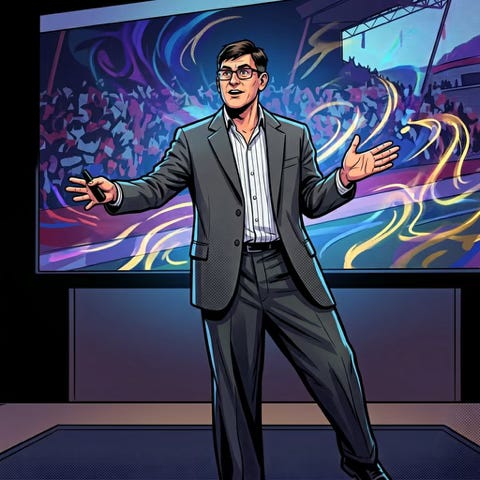
#2: The Man Onstage
A few months later, iMedia and Variety were co-producing an event about entertainment marketing (how to get people to go to the theater, turn on the TV, or, back then, buy a DVD). As we sat around a conference table pulling together an agenda, we realized that we needed a research presentation: somebody to talk about how the internet, particularly the web, changed how audiences found out about and consumed entertainment. Nobody had an immediate idea about who should do this.
“I’ll do it,” I said. Quizzical looks then ping-ponged around the table, and I had my first experience with telepathy because I could see what my colleagues were thinking. “Can he do this?” “Well, he does have a Ph.D.” “It’s a 15 minute presentation—how much damage could he do?” I got the gig.
Digression: as I said to La Profesora’s students last week, “I’ll do it” are three of the most career advancing words you can ever say. The time to say them is a moment just after people have realized that a job needs to get done, but nobody is quite sure what the job is or who can do it. Saying “I’ll do it” is high risk/high reward. (I once said these words about a corporate website redesign on the second day at a new job, but that’s a story for another mini-memoir.) End of digression.
Having the research presentation assignment, I now had to figure out three things:
What I was going to say.
How to use PowerPoint, which I had never done.
Who I was going to be onstage.
The last was the most important. I understood the overall trends well, and PowerPoint was a steep but short learning curve. But my onstage persona needed to deliver the goods for that event’s audience, and it was going to send a message to my colleagues and the industry at large about my abilities for the future.
As I shuffled through my different experiences, the question I asked myself was “who does the audience need me to be? And what is the closest experience I have to that person?”
As a grad student back at Cal, I was the only teacher who insisted that my students call me “Mr. Berens” rather than “Brad” because I wanted them to take the class seriously. If my peers channeled Mr. Rogers, I channeled Louis Gossett, Jr. in An Officer and a Gentleman. (I also needed to hide the fact that I’m a big softy with a gooey center, which they would have taken advantage of ruthlessly.)
That was the analogy: the audience at that industry event needed “Mr. Berens,” the guy who had taught hundreds of classes and thousands of students. The guy who could never let a room full of adolescents sense fear because they were like sharks smelling blood. That’s who showed up.
I killed it. The audience laughed, applauded, and got the key points I was making about digital disruption in entertainment. As I walked offstage, my colleagues all looked stunned, which was a bit insulting. Since then, I’ve given invited talks all over the world… all because I found the right analogy.
Why this is important right now.
My son William is 20. He’ll graduate from college in 2027. His first job out of college will be something recognizable to most folks, but his third job hasn’t even been invented yet. This would be true even if ChatGPT hadn’t kicked off the AI revolution in November of 2022, but with the rise of chatbots and agentic AI change has accelerated.
For William and his peers, the ability to think analogically will be a critical skill as they begin careers where pivot after pivot after pivot will be the norm. It’s not just 20 year olds: we all need to think analogically to navigate our swiftly-changing world.
Thanks for reading. See you next Sunday.
* Image Prompt: “The attached is a photo of me giving a TEDx talk in Bergen, Norway, in 2014. Please transform it into a comic book style version of the phone, square. Please remove both the TEDx logo and the Bergen flag in the background. Please zoom in on me while leaving my entire body visible.”
** It delights me more than I can easily convey that in the index to Rishad’s book there are entries including, “Turd on the table, defined, 54” and “Turd on the table, various forms of a, 54-55.” I will also direct your attention to “‘Turd is a Brownie’ phenomenon, 56-58.” Rishad’s ability to write sagely about business while simultaneously talking about turds is one of the things that makes him a powerful thinker and writer, and it also cracks me up.
Let's not forget this quote by Aristotle, "The greatest thing by far is to be a master of metaphor; it is the one thing that cannot be learnt from others; and it is also a sign of genius, since a good metaphor implies an intuitive perception of the similarity in the dissimilar."
By the way, you mean "fan fic," but what's written is "fan pic." See you soon!