Keyword: Ostranenie
Art and other stimuli exist to nudge us out of automatic recognition into seeing things afresh, which is more important now than ever. Plus, things worth your attention, the lighter side, and more!

No Dispatch next week—La Profesora and I will be visiting the Oregon Shakespeare Festival, which I heartily suggest that you do, too. We are seeing a new adaptation of Jane Austen’s Emma, Shakespeare’s A Midsummer Night’s Dream and King Henry IV: Part One. I am excited!
Before we get to today’s main topic, some miscellaneous goodies and things worth your attention…
Education Roundup
Brown Professor Suspects Majority of His Class Used AI to Cheat. Don’t miss this piece from Inside Higher Ed. Economics professor Roberto Serrano (at Brown, my alma mater) gave students the option of a take-home midterm. The average score was 96%, unprecedented and likely the result of students using AI to help with their exams. This is just one example of a widespread phenomenon that is changing education quickly. (H/T Peter Horan.)
Under a new federal rule, colleges must leave grads better off or lose financial aid. This NPR story digs into a new “do no harm” test from the U.S. Department of Education. At first blush, it looks like more MAGA anti-intellectualism and hostility to education, but it’s worth listening to or reading the article because the reality is more nuanced. For profit universities (e.g. University of Phoenix) are among the worst, which isn’t surprising.
School choice for me, but not for thee. A Washington Post ($) op-ed by Corey DeAngelis of the conservative Heritage Foundation tries to make hay out of the fact that three Democratic senators against school vouchers sent their kids to private school. The writer critiques, “lawmakers who benefited from educational options they now want to keep out of reach for many families across the country.” But DeAngelis’ math doesn’t math. When parents put a kid into private school, the parents’ taxes still fund public schools. There’s no inherent net loss to the public schools (although it’s more complicated than that). School vouchers that allow parents to redirect their taxes to private or parochial schools take that money away from public schools, leaving other children poorer. Is it a disgrace that American public schools are not good enough for some wealthy parents to put their kids there? Yes. Is the answer to starve those schools of funding? No.
Opioid of the Masses. On July 4th, The Atlantic republished a piece by JD Vance on its 10th anniversary. The piece is, to understate the matter, critical of Donald Trump. For example: “Trump’s promises are the needle in America’s collective vein.” A decade later, Vance is (to quote one of my favorite lines from the movie The Tall Guy) Trump’s toadying, sycophantic suck butt. This only cements my take on Vance as an apex cynic.
What’s the Point of Sex, Anyway? by Elizabeth Kotler in The New Yorker ($) is an intricate review of three books about the wild variations around sex in the animal kingdom. It is fascinating and hilarious. The piece is also quietly political, implying that notions of what is and is not natural in the MAGA attack on diversity have no connection to what exists in nature.
Nestlé to Tweak Some Food Recipes to Appeal to Duller GLP-1 Palates (WSJ $). As I’ve shared before, I’m on Mounjaro, and I haven’t noticed any dulling of my tastes. Nestlé’s exploration of how to create snacks for people on GLP-1s is part of a larger disruption. At the Center for the Digital Future, we’ve been tracking this since 2024. Jeffrey Cole has a series of columns that share our thinking. Here’s the first one.
An epidemic of online elder fraud is real. Here’s a Washington Post ($) piece that describes the scope of the problem and offers three immediate things the government can do to help.
‘Even the test mice are male!’: 5 shocking ways sex bias shapes women’s healthcare. I wish that this piece from the BBC were more of a surprise. It’s still a must-read. The extent to which the medical establishment disserves women across research, pharma, and treatment is, frankly, disgusting.
The Billionaires’ Vagina Club from The New Yorker ($) is hard to describe, but it’s a great read.
If you like what you’re reading, please forward to a friend. Sign up is here.
Practical Matters:
Sponsor this newsletter! Let other Dispatch readers know what your business does and why they should work with you. (Reach out here or just hit reply.)
Hire me to speak at your event! Get a sample of what I’m like onstage here.
The ideas and opinions that I express here in The Dispatch are solely my own: they do not reflect the views of my employer, my consulting clients, or any of the organizations I advise.
Please follow me on Bluesky, Instagram, LinkedIn, and Threads (but not X) for between-issue insights and updates.
On the lighter side…
Lone Star. La Profesora and I re-watched this fantastic 1995 John Sayles movie. We got it out of the library, but you can rent it from Prime for $4.
A friend’s upcoming hip replacement surgery reminded me of Steve Carrell’s hilarious account of his own hip replacement on the Jonathan Ross show from 2015.
I Survived a Cold Plunge and All I Got Was Everything I Ever Wanted by Taffy Brodesser-Akner in The New York Times ($) is both interesting and funny. I enjoyed her novel, Fleishman Is in Trouble, even though I missed the later adaptation on FX.
On to our top story... which is part of a “Keywords” series that I’ve slowly built over the history of The Dispatch.
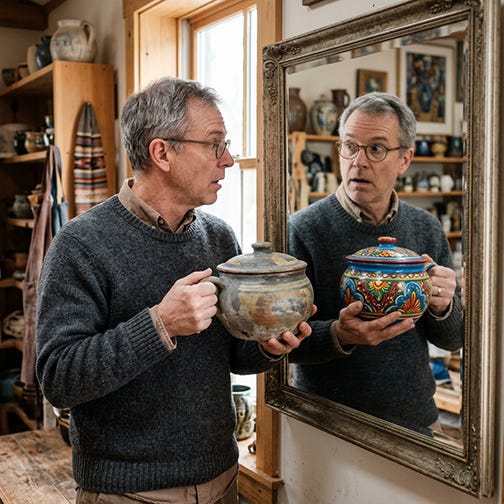
Keyword: Ostranenie
Oh, happy day! My son returned last night from five months of study abroad in Auckland. La Profesora, his girlfriend, and I greeted him at the airport, after which we went our separate ways: La Profesora and I to a dinner party, the other two off to their own devices.
How, I wonder, has this experience changed my son? It surely has, but what will he keep private and what tendrils of subterranean growth will creep up into daylight visibility? One tendril has already popped into view. He came downstairs after the first burst of unpacking and said, “I have a lot of clothes.”
When he left in February, he brought two pieces of luggage: one suitcase and a duffel. He has been living for a season and a half with a limited wardrobe, so now the closets at home seem to bulge. He has begun to prune.
My son’s time away from home and from his stuff allowed him to see things afresh upon his return, instead of merely recognizing them. Seeing versus recognizing is an important distinction that I first ran into in the work of the Russian Formalist critic Viktor Shklovsky.
In his famous (for lit crit types anyway) 1917 essay “Art as Device,” Shklovsky coined the term “ostranenie,” which means “defamiliarization” or (my preference) “making things strange.” It has also been translated as “enstrangement,” which is itself a strange-looking, strange-sounding word that amplifies the making-strangeness of the idea of ostranenie.
Ostranenie is one of the most useful ideas I’ve encountered. For Shklovsky, ostranenie explains the purpose of art, which is to make things strange so that we can see them again, instead of merely recognizing them. But ostranenie’s value as a concept extends beyond why we have art and what art does to our minds.
I’ve written about ostranenie before (in “Wonder Moments”), where I compared Shklovsky’s recognizing vs. seeing to Daniel Kahneman’s System 1 (thinking fast) vs. System 2 (thinking slow) and to schema-driven processing vs. data-driven processing in social psychology. In all three distinctions, the tradeoff is between getting through a high volume of information quickly and being able to understand, appreciate, or question pieces of information along the way.
It has never been more important or more difficult to evaluate information, and the reason for both the importance and the difficulty is how much more information there is now, by many orders of magnitude, than there ever has been before. We’ve been talking about information overload (and filter failure) since the dawn of the publicly available internet. Now, with the arrival of publicly available AI-generated information, the problem has become incomprehensibly bigger.
Information overload is turning into an information fugue state where we don’t know what is real, what is hallucination, and who we are in relation to all this information.
An analog oasis?
My son’s return from New Zealand (and realization that he has a lot of clothes) sparked a new question about ostranenie: is it—and, if so, how much is it—analog by necessity?
The answer, I suspect, is that ostranenie is not inherently analog, but analog objects and environments better the odds at escaping recognition and seeing things anew. Analog has more friction than digital, and friction increases dwell time with an idea, which is key to seeing rather than recognizing.
Walking through a museum or a garden, listening to birdsong, reading a paper book or magazine or newspaper, cooking rather than microwaving, listening to live music, attending theater or a movie in a movie theater, writing with a fountain pen on nice paper rather than tapping on a piece of glass or a keyboard, any of these things can provoke seeing rather than recognition.
However, the opportunity cost of single-tasking—that is, doing any of those things without also looking at your phone—gets harder and harder.
The enstranging effect of art and other startling stimuli (the “wonder moments” I mentioned before) pushes us out of the whirligig of digital information into moments of contemplation (Kahneman’s “thinking slow”)… if we get lucky.
We get lucky less and less often. The cover story of the newest (August) issue of The Atlantic is “The Age of Reading is Over,” by Rose Horowitch. It’s a long, thoughtful piece.
For Horowitch, the decline of reading—with its concomitant declines in contemplation, comprehension, and critical thinking—causes our polarized politics and newly “postliterate,” superficial, fact-agnostic society. It’s a dystopic piece that provides scant hope.
I’m more optimistic, although not much. The mental muscle we need to build doesn’t necessarily require reading, although reading yields fathomless benefits.
The first step is to get away from screens, step outside, look at things, look at other people, and strive for patience while we do it.
Here are two final questions.
First, what are the minimum viable conditions for ostranenie—for seeing instead of recognizing? If the answer is, “five months in New Zealand,” like my son’s experience, then hope is lost.
Second, can we (and how can we) as a species embrace seeing as part of mental health?
Addictive, attention-sucking algorithms stack the odds against us the way addictive processed foods make healthy eating a struggle. However, lots of folks still try to eat healthily and exercise. We don’t have a similar consensus that higher friction contemplation is healthy thinking.
We need it.
Thanks for reading. See you Sunday, July 26th.
* Image Prompt: “A 4x4 photorealistic image. A middle aged white man wearing glasses holds a painted clay cooking pot up to a mirror. In real life, the clay pot has muted colors, almost gray. In the mirror, the paint on the clay pot has vibrant, vivid colors. The man has a mildly surprised expression, looking at the mirror image of the clay pot.” Firefly got it right the first time, which is rare. Note that the man’s wedding ring switches hands between the two images.