Wonder Moments
When something makes you notice and appreciate the technological marvels that we all take for granted, pay attention. Plus, lots of goodies and things worth your attention. (Issue #200)

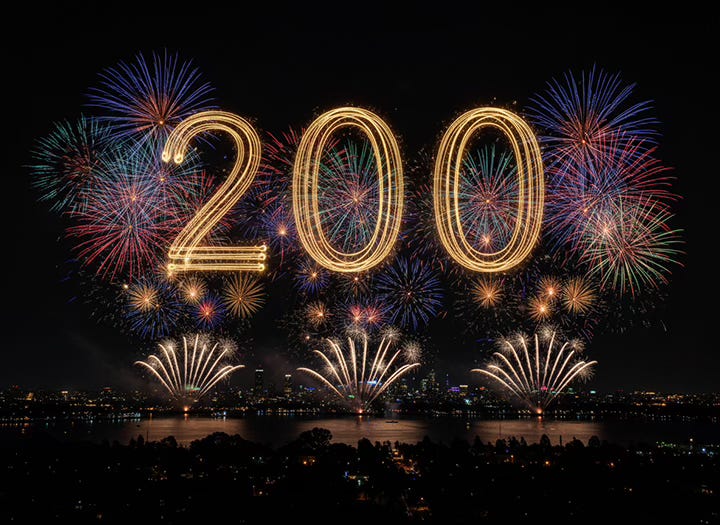
Attentive readers might have noticed that that I had planned this, my 200th Dispatch, to go out last Sunday instead of today. Alas, bedeviled by circumstance and swept away by distraction I didn’t have the bandwidth to write. One of the happier interruptions was this:
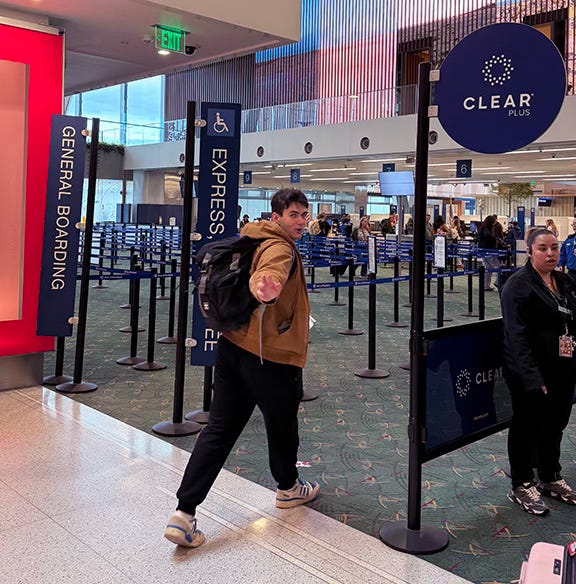
My 20-year-old son William is off to Auckland for a semester abroad.
Before we get to today’s main topic, some miscellaneous goodies and things worth your attention…
A gray wolf has visited Los Angeles for the first time in a century. (NYT $).
Professors on Food Stamps: This recent Instagram post by Wealthy Educator (words that are typically oxymoronic; this is the nom de plume of Chris Travers) about how universities exploit adjunct professors echoes my recent piece, Will Teach for Food. (H/T Peter Horan.)
Are Mass Market Paperbacks a thing of the past? Probably and sadly, per this NYT article ($). (Another H/T for Peter Horan.) I have thousands in my garage. I suspect that my grandchildren will not be able to make sense of the Beatles’ song “Paperback Writer” the way my kids can’t understand the record store scenes in High Fidelity.
Composting as an alternative to burial or cremation is getting traction (WSJ $), which I think is a great idea. I’d much rather be returned to the soil and help grow things than either a) take up space in a cemetery that nobody will visit after a few years or b) turning my corpse to ashes in a way that pollutes and uses too much energy. See also Jeffrey Cole’s 2022 piece about how corrupt the funeral business is and how Costco (!) is coming to the rescue.
What could possibly go wrong with Facebook adding facial recognition to its Meta Glasses (NYT $)? As cryptocurrency is to money laundering so will this technology be to stalking, privacy invasion, corporate and government surveillance, and all sorts of fraud. Way to go, Zuck. (And we all know what Zuck rhymes with.)
Take a look at the AI-generated ad for a fake soda featuring the Mona Lisa (WSJ $). ByteDance, the company behind TikTok, has a new video-generation model called Seedance that rivals models from Google and elsewhere. Hollywood is, of course, experiencing conniptions.
The Supreme Court overturning Trump’s tariffs was a pleasant surprise. Trump then doubling down and swearing he’d find other ways to levy the tariffs was no surprise at all. I’m glad that the president is doubling down, though, because if he hadn’t then the economy for working people might have perked up just in time for the midterms.
Thank You and Happy Birthday to my friend Rabbi Cyn Hoffman, who was a last-second consultant on our main story this week.
If you like what you’re reading, please forward to a friend. Sign up is here.
On the lighter side…
Mark Twain once wrote that the difference between the almost right word and the right word “is the difference between the lightning bug and the lightning.” This came to mind as I’ve been reading Impossible Owls, an essay collection by Brian Phillips. (I mentioned a more recent essay of his a couple months ago.) He is a gem cutter when it comes to word choice. Here’s a passage from the first essay in the collection about traveling to Alaska for the Iditarod:
How can I tell you what it was like, standing there under the trillion-mile blue of the Alaska sky, ringed in by white mountains, resolving to take to the ether in one of these winged lozenges?
I love many things about this sentence: the use of “trillion” and “ether,” for example, and I nearly gasped at “lozenges.” Wow. The essay originally ran on Grantland.
In-N-Out Burger is coming to the greater Portland Metro area! IYKYK.
Caveat Frogs on Instagram is delightful. (H/T Dense Discovery.)
My latest ear worm: Why, oh why, is the theme song from The Patty Duke Show going through my head over and over? This has prompted other thoughts, like, “could there by a Parent Trap 2 where Lindsay Lohan plays the moms with ‘identical cousins’ played by another young actress?” Or the moment in Mr. Saturday Night where Buddy Young and his brother Stan are walking together and Buddy says, apropos of nothing and of the theme song, “’a hot dog makes her lose control?’ Waiter, a Hebrew National for the young lady, and keep ‘em coming!” (For those unfamiliar with this 1960s sitcom, it’s streaming free on the Roku Channel.)
Practical Matters:
Sponsor this newsletter! Let other Dispatch readers know what your business does and why they should work with you. (Reach out here or just hit reply.)
Hire me to speak at your event! Get a sample of what I’m like onstage here.
The idea and opinions that I express here in The Dispatch are solely my own: they do not reflect the views of my employer, my consulting clients, or any of the organizations I advise.
Please follow me on Bluesky, Instagram, LinkedIn, and Threads (but not X) for between-issue insights and updates.
On to our top story...
Wonder Moments
Last Wednesday, my first meeting was a Zoom with one person in Warsaw (6,000 miles away) and another in Palo Alto (a mere 350 miles away). I’m in Los Angeles visiting family. I have global meetings like this all the time, but for some reason it struck me afresh how incredible it is to have such a face-to-face-to-face meeting across two time zones and three geographies.
Later that day, I was driving to Pasadena to meet a friend for coffee when my son William texted me a question from Auckland. I couldn’t text back (driving), so I hit the little button and called him. “Hi Pop,” he answered. We chatted for a minute or two about his question, then he disconnected, and I kept driving. Huh, I thought to myself. Isn’t that amazing?
Auckland is 6,500 miles away in an entirely different direction than Warsaw. In the between hours, I’d had meetings with people elsewhere in California, in Oregon, Chicago, New York and the Philippines. These are typical events in my life, and most of the time I don’t notice.
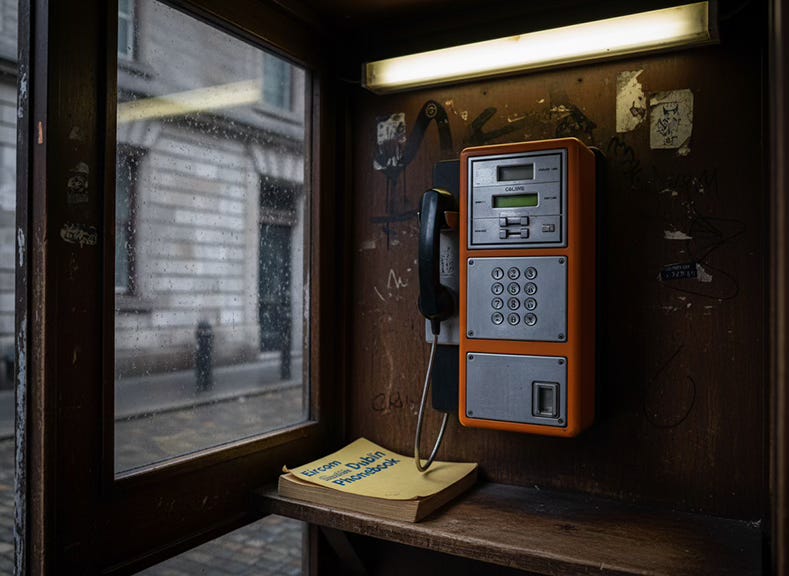
Decades earlier in the 1980s, I did my own study abroad at Trinity College Dublin. At that time, I traded letters and postcards with friends and family: each piece of mail was a dislocated snapshot of our lives. Sunday phone calls to my parents were expensive and brief. One day, the pay phone in Trinity Hall (the dorm for international students) started giving out free calls to anywhere on the planet. We all took turns calling faraway friends and family. It was terrific, so long as you didn’t mind a loud beep! interrupting your conversation every 20 or 30 seconds. Nobody minded. Soon, two large men from Telecom Éireann walked into the lounge, ripped the pay phone out of the wall, and walked back out.
Those free calls, talking in real time, without anxiety about how much each minute cost, were delicious. I could hear voices that for months had been handwriting. That was in the 1980s.
Today, I have unlimited, low-cost or free communications with anybody I want to chat with—audio and video—anywhere on the planet. The confluence of my global Zooms and then casual chat with William in New Zealand jarred me out of my automatic, habitual acceptance of these remarkable, enabling technologies.
It was a Wonder Moment.
Wonder Moments are the precious, positive flip side of Adapt-amnesia, which happens when we get so accustomed to something (e.g. high-speed internet) that we forget browsing used to be slower until, yikes, we have to use a low-speed connection again and go nuts because we don’t want to wait. They can be a form of time travel, but unlike specific evocations of time past Wonder Moments can also make you see the present from a new angle.
Wonder Moments happen when something startles us into shifting from one kind of thinking to another. Different thinkers describe this shift in different, complementary ways.
In 1917, in his famous essay “Art as Device,” the Russian Formalist critic Viktor Shklovsky articulated the difference between seeing and recognizing. To see a thing was to experience it in depth, in context, and vividly. To recognize a thing was, by comparison, an impoverished experience. The purpose of art, he argued, was to make things strange so that we could stop recognizing and see them once again. His term for this strange making was ostranenie, one of the most useful ideas I’ve come across.
Social psychologists distinguish between data-driven thinking and schema-driven thinking, where the first is similar to Shklovsky’s seeing and the second is like his recognizing. Data-driven processing is more resource intense than schema-driven. Data-driven processing also makes things seem to last longer, which is why a long weekend away in a place you’ve never been to before can seem like a week.
Likewise, in Thinking, Fast and Slow, Daniel Kahneman distinguished between laborious and lazy System 2 thinking (the slow kind) and lightning-quick but inaccurate System 1 thinking (the fast kind). We need both to navigate the vast—and increasing—amount of information in our moment-to-moment lives. If we only used System 2, then we’d run out of mental energy before finishing that second cup of coffee in the morning. However, System 1 makes a lot of mistakes that can get us into trouble.
Tripping over a Wonder Moment means falling into appreciation, seeing, noticing, embracing the parts of an experience that don’t fit into habitual schemas or System 1’s easy heuristics.
In a Wonder Moment, the outside world remains the same. The only thing that changes is your perspective. This is akin to the vestigial Jewish notion of heaven versus hell. They are the same place, but when you’re in heaven you can appreciate it, and when you’re in hell you can’t: same place, different experience. A Wonder Moment changes your experience, and you don’t move a muscle.
I don’t get Wonder Moments all that often, so when I do I try to embrace them. Wonder Moments are a caesura, a pause, a brief frozen moment that then thaws into the rushing water of quotidian experience. If I’m lucky, I can notice the temperature, feel the wetness on my skin, and float rather than sink beneath the rest of my day.
Thanks for reading. See you next Sunday.
* Image Prompt: “The number 200 lit up in the night sky as exploding fireworks.” It’s worth noting that I did not ask Firefly to include the cityscape below.
** Image Prompt: “An old-style, 1980s era pay phone, in Dublin, Ireland, mounted on a wall in a wooden cubicle with a shelf below. On the shelf is a paper phone directory. “An old-style, 1980s era pay phone, in Dublin, Ireland, mounted on a wall in a wooden cubicle with a shelf below. On the shelf is a paper phone directory.”
Mark Twain once wrote that the difference between the almost right word and the right word “is the difference between the lightning bug and the lightning.”